

How I got here
Like many of you, I’ve worn a lot of hats in this lifetime — and I’ve loved them all. I started as a biochemist, fascinated by the tiny molecules that make up our bodies and the stories our genes tell. In the lab, I learned how to ask good questions, read data instead of vibes, and stay curious even when the answers were messy.
From there, I followed my love of technology into Silicon Valley, climbing corporate ladders until the cubicle walls felt too tight. That season taught me leadership, strategy, and how to navigate complex systems — skills I still lean on when I’m helping someone untangle a big, knotty life decision.
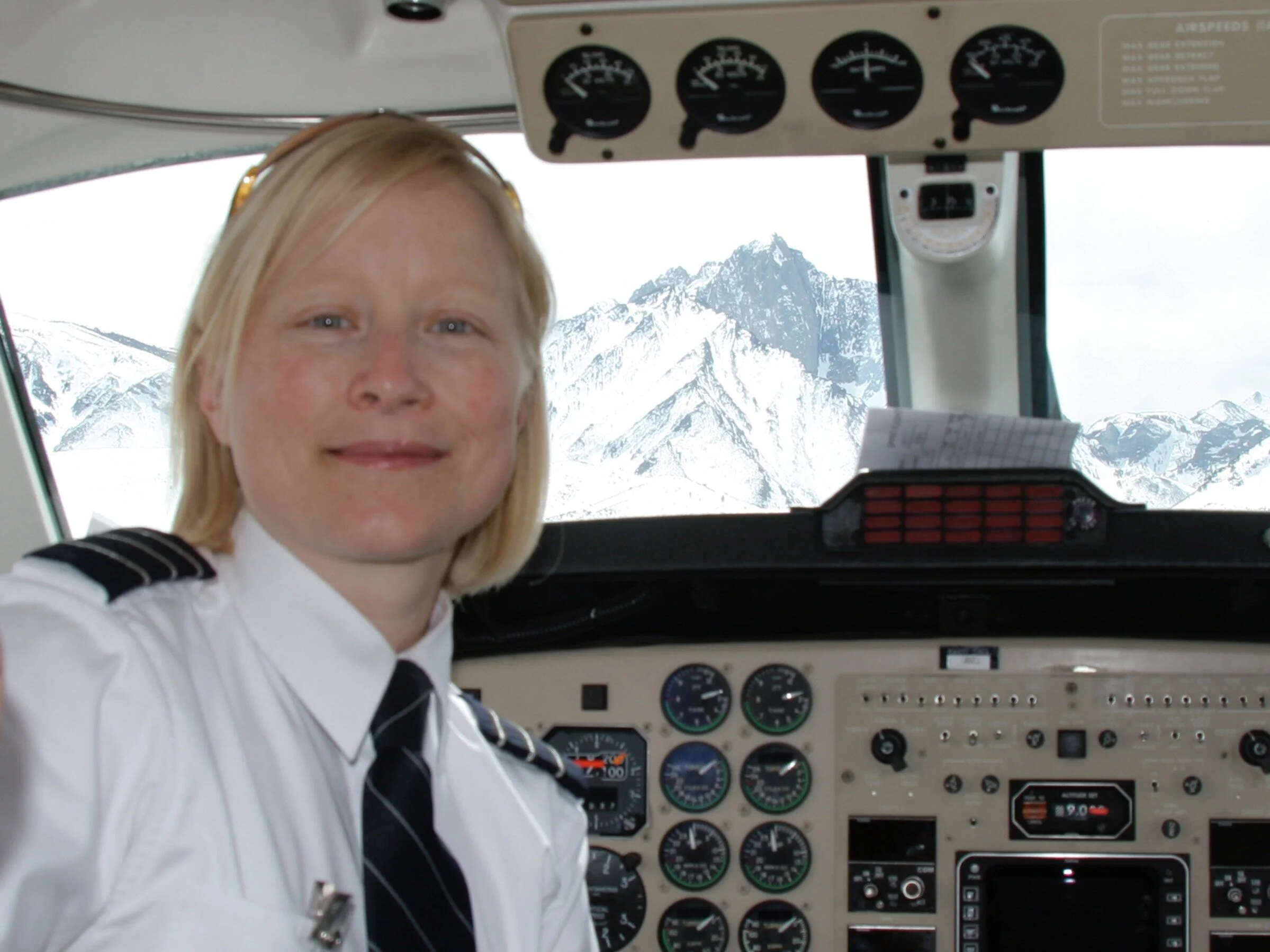
Eventually, I reinvented myself as a pilot and became captain of privately owned executive aircraft. In the cockpit, risk mitigation wasn’t a metaphor; it was non‑negotiable. I learned how to chart a course, adjust mid‑flight, and stay calm when the sky didn’t match the forecast or something went sideways with the aircraft.
All along though, being in the outdoors was my constant. I was the one racking up miles on mountain trails by bike or on foot, chasing ridgelines and quiet canyons. Nature was where I went to feel small in a good way, to remember that there’s always a bigger landscape than whatever goal I was grinding toward.
Underneath all this, I had silently accepted exhaustion and burnout as the price of admission — and I hadn’t yet paused to question that price.
The dream changed in an instant
For years, I flew business aircraft across the western U.S. and Canada and genuinely loved the work. It drew on my love of precision, navigation, and being trusted with what mattered most.
Then a routine medical exam led to a Hashimoto’s diagnosis that proved unusually hard to stabilize. Because of that, I had to step away from the cockpit.


The perfect plan, that didn't work
No problem, I got this!
The biochemist in me was sure I could find the right variables to tweak. The professional in me believed a solid project plan could fix anything. And the pilot in me trusted that if I followed the “flight plan” precisely enough, I’d arrive at the destination of restored health.
So I threw myself into it. I worked with specialists, tried protocols, adjusted diet and lifestyle, and treated my body like a project I could manage into compliance. Restoring my health quietly became a second full‑time job — and my inner story narrowed to illness, labs, and whether I was doing it “right” enough.
But a year in, I still felt awful more days than not. I wasn’t cleared to fly again, the recommendations were getting more extreme, and underneath it all was a growing ache: if I was “doing everything right,” why wasn’t it working?
That question became my first real wake‑up call. Blindly following plans — whether from conventional medicine or the wellness world — wasn’t going to rescue me. Something deeper in the way I understood control, health, and myself had to change… even though I didn’t yet know what that would look like.

The slow, uneven climb back
Emerging from that first season of illness wasn’t a single before‑and‑after moment; it was a slow, uneven climb. Over time, with a mix of medical care, lifestyle shifts, and nervous‑system work, I began to feel more like myself again. The fog lifted enough that I could see possibility on the horizon instead of just lab results and limitations.
As I experimented, I found tools that genuinely helped: nutrition tweaks that made a difference, practices that calmed my system, mind–body techniques that shifted long‑held patterns. That exploration eventually led me into health coaching, functional medicine–style work, and deeper training in things like NLP and transformational coaching.
But here’s the part I couldn’t see yet: I was still carrying an unspoken belief that if we just found the right protocol, supplement stack, or mindset shift, we could largely control our health outcomes. That story sounded empowering, yet it was also brutal; quietly setting people (including me) up to believe they were doing something wrong if life, bodies, or fate didn’t cooperate.
I didn’t know it then, but another set of experiences was coming that would challenge that belief at its core and eventually lead me out of the wellness industry altogether.

When the wellness story cracked open
Years later, life handed another plot twist I never would have chosen. I had a SCAD heart attack in 2024 (learn more here), and about six months later my husband was diagnosed with late stage 3 colorectal cancer. By every wellness metric, we’d been “doing it right” for years — food, movement, sleep, supplements, labs, red lights & PEMF mats, bio-metric trackers — literally all the things. And still, here we were.
In the middle of shock and fear, a different kind of noise showed up. People came out of the woodwork with confident opinions and very little evidence: blaming vaccines, promising miracle gadgets, sending us cure‑all protocols that had more affiliate links and discount codes than data behind them. As a chemist and a biochemist, my husband and I knew how to read studies, tell the difference between a mouse trial and a clinical trial, and ask, “What does the body of evidence actually say here?”
That season broke something open in me. I saw how often the wellness world quietly implies that health is 100% under our control if we just try hard enough — and how cruel that story becomes when bodies do what bodies sometimes do. I also saw how “don’t trust Big Pharma” can morph into “trust my discount code,” with very little scientific rigor in between.
I realized I no longer wanted to be part of that ecosystem. I didn’t want to run your labs or sell you on the idea that the right protocol could save you from ever getting sick again. I wanted to help people do something different: face uncertainty with more support, navigate scary diagnoses with better questions and better information, and take brave steps toward the lives they actually want — even when there are real risks on the table.
How I walk beside people now
These days, I don’t promise perfect health or magic fixes. What I offer is something different: a grounded co‑pilot as you navigate big change — whether that’s a scary diagnosis, a long‑held dream that suddenly glimmers with possibility, or a quiet knowing that you’ve outgrown an old identity.
We look at your life the way a scientist and a pilot would: gathering data, asking better questions, getting second opinions, assessing risk and mapping options instead of clinging to one “right” path. At the same time, I help you tune into your own intuition — what it actually feels like in your body, how it “speaks” to you, and how to trust it alongside the evidence instead of overriding it or outsourcing it.
We work at the level of identity and nervous system so that, by the time you step into the new chapter, you’re not just trying on a new life — you’ve become the person who can live it. This is the heart of my BioNeuro Blueprint™, a framework that weaves together your lived experience, nervous system patterns, and core values into a roadmap you can actually trust. That essence lives inside the containers we work in — ONE : ONE Guidance, Re‑Wild Immersions, and my self‑paced journeys like Deep Transformation and Integrate & Elevate.
Alongside my private work, I’m a founding board member of Kizuki Foundation, a nonprofit that inspires wonder and everyday stewardship for Earth’s diverse biomes. We create immersive, research‑driven storytelling, community‑powered experiences, and accessible resources that help people fall a little more in love with the natural world — and support responsible conservation in the places they call home.
This work isn’t about fixing you.
It’s about learning and trusting your own truth and intuition — and letting everything that isn’t burn away
Certificates & training
I’ve always been a bit of a nerd about patterns — whether in biochemistry, ecosystems, or human behavior. My formal training started with an undergraduate degree in biochemistry and has woven through psychedelic neuroscience, nervous‑system work, transformational coaching, and other modalities that look at how meaning and identity are created. All of it now serves one purpose: helping you navigate big change with more clarity, choice, and self‑trust.

On the science side, my undergraduate degree in biochemistry, along with additional work in psychedelic neuroscience and microdosing education, has given me a deep respect for evidence, research design, and the limits of what we actually know. Programs like Demystifying Psychedelic Neuroscience and a Microdosing Practitioner Training inform how I think about mechanisms, set and setting, and risk. I don’t run labs or practice functional medicine anymore, but I do help you make sense of information, ask better questions, and understand how different options might interact with your real‑world life and risk profile.
From my aviation career, I bring a practiced lens for risk assessment and analysis — the discipline of seeing the whole field of possibility, naming real constraints, and then choosing how to move forward with eyes open. That background means our work can hold both vision and safety: we can explore the edges while still honoring your nervous system, your responsibilities, and what truly feels like a wise next step.
On the human side, certifications and training in Neuro-linguistic Programming (Level I and Master NLP Practitioner), Transformational Coaching Method, Transformational Coaching Academy, Institute of Spiritual Coaching, Energetics & Manifestation, Total Body Mastery, and Human Design (Levels I & II) taught me how identity, story, and nervous systems shape what feels possible. My time teaching and participating in a women’s Professional Pilot Leadership Initiative mentoring program deepened my formal mentoring skills and my commitment to relational, matriarchal models of leadership — where we rise together, not alone.
I’ve also spent about 15 years working in the technology and software industry, and invested in business, sales, marketing, and wealth‑building trainings. That combination of lived experience and formal learning means I understand what it takes to build a life and career that are actually aligned with who you are, while still honoring practical realities like money, capacity, and constraints.
What ties all of this together isn’t a single modality; it’s my ability to synthesize complex ideas into simple, usable frameworks. You don’t need to keep track of all the acronyms. You just need to know that when we work together, you’re teaming up with a co‑pilot who can hold both data and mystery, research and intuition — and help you stay oriented to your own truth while you walk your path.